Friday, August 26, 2022

How to Use Instax Mini film in a 127-Format Twin-Lens Reflex Camera - by Umechan

Editor’s note: This article originally appeared in Japanese on April 20, 2021 here. With Umechan’s permission (and at her suggestion), I’ve auto-translated the original (using both DeepL Translator and Google Translate), and edited the result for clarity. Umechan has checked my version using electronic back-translation, and collaborated with me to resolve the ambiguities that inevitably arose. 


I’ve made a wonderful discovery! That's right. A 127-format twin-lens reflex camera (TLR) can (relatively) easily expose, develop, and print Instax Mini film!

I'm not sure if this is a good idea or not. I guess you have to find out by trial and error, don't you?

First of all, I’d like to show you the 127-format TLR that I used.

It's a Baby Rolleiflex 4x4! It’s no exaggeration to say that this is the best 127-format TLR.

The most prominent feature of this baby TLR is that the film is (almost) extinct. There are few ready-to-use 127-format films available. You can also spool bulk 46mm film onto 127-size spools and backing paper (see this article). Or you can cut down 120 film yourself (see these articles). I made my own 127 film with a 127-size film cutter that I happened to have received and I took a few pictures. The pictures look very good! 

Good, very good!

Normally, this Baby Rollei takes great pictures!

However, as mentioned above, it’s very difficult to procure film. During a time when I was alternating between taking pictures and not taking pictures because of the difficulty of obtaining film, I suddenly remembered an article. It was titled, "Putting Instax film into an Atomflex format camera and taking pictures.” At the time, I didn't even own a Baby Rollei, so I just thought, "I didn't know there was such a way to use it.” But then my curiosity was piqued, and I started to wonder, "Will the Instax film fit in the Baby Rollei?" I was so curious that I tried to put Instax Mini film into the Baby Rollei’s film chamber to see if it would work.

What a surprise!

The film chamber of the Baby Rollei and the Instax film are almost perfectly aligned!

And since the Instax film is slightly smaller, it seems that it can be fixed in a very good position!

I had no choice but to try it! Here is a photo I took the next day, even though I had to work.


Whaaaaaaaat! You can take very beautiful pictures!

Of course, the Baby Rollei is 4x4 size, so it will capture square format. Some people might say that it doesn't use the entire film surface area, but I think it has a nice black border, and I like that a lot.

And this is taken with the camera wide open (f3.5). I focused on Pikachu, and you can see Pikachu very clearly. In other words, the film is firmly fixed!

I thought, "This, this is the future of 127 format...!"

So I took a lot of pictures in the next few days.

I can do it, I can do it, I can do it!

My curiosity turned into confidence.

Of course, there were some photos where the film was incorrectly exposed during the process, but I was happy to be able to think, "Well, it's an Instax, so what the heck.” :-)

Well, now.

I'm sorry for the long introduction, but this technology(?) is very useful and must not be lost.  So, I'm going to write about how to do it.

But first.

The method I’m going to describe here is an example of how I’ve succeeded in using Instax film with a Baby Rollei. Please understand that there are individual differences and that it may not work with all 127-format TLRs. Also, since I’m using the camera in a somewhat unreasonable way, I can’t guarantee that the camera won’t break. Please try this at your own risk.

First, let's start with what you'll need to prepare.

  • 127-format TLR
  • Instax Mini film
  • Instax Mini camera (used is totally fine, as long as the film ejection mechanism is working properly)
  • Dark bag or darkroom (it's possible to use a darkroom, but a dark bag is by far more convenient)
Now, let's look at the actual exposure and development method.

1. Remove the case of Instax Mini film from the box.

Put it in on the left side.

2. Prepare the Instax camera.

This Instax camera will be used only as a "developer." Since we will not be using any lenses or flashes with this camera, shield them so that as little light as possible reaches the film.


By the way, some cameras do not allow you to turn the flash off. Therefore, you should shield the flash part as well. Unfortunately, the first-generation Instax I purchased this time did not allow the flash to be turned off. You can see that I’ve taped over both the lens and the flash. It's a miserable sight to see, but it's for the sake of your precious film.

3. Put the film case in the Instax camera and release the shutter once.

The purpose of this is to eject the light shield that comes with this Instax film. It’s possible to take out the light shield in the dark bag, but that’s a hassle, so let’s do this by releasing the shutter.


Match the yellow mark on the film case with the yellow mark on the Instax camera, and 


Release the shutter!

The light shield has come out.

4. Place the TLR and the Instax film in the dark bag, and put one sheet of Instax film into the TLR, as follows.

This must be done inside the dark bag. In the illustrations, it’s done in the light so that you can see it, but please make sure to do this in the dark bag.

In addition, the work to be done inside the dark bag from now on will create a black border for the photo.

First, open the film chambers of the Instax camera and the TLR.

Take out the Instax film case.


Remove a sheet of film from the film case.

If there are many sheets remaining in the case (up to about 6 or 7), slide the film out with your finger.

When the number of sheets remaining is less than about 5 or so, it becomes difficult to remove them. In that case, gently press the opposite side of the "Don't press with your finger!" mark on the other side, and slide the film out while pressing down lightly. :-)

Place the film in the film chamber of the TLR.

The film should be placed with the note field facing up. Also, since the front and back sides of the film feel very similar, it is very easy to make a mistake (I made this mistake twice). Be careful.

Then, put the film case back into the Instax camera and close each film chamber. This completes the loading process. Now you can take the TLR out of the dark bag.


5. Take a picture.

Get your best one with your 127-format TLR!

One thing to note is that Instax film (both color and black and white) has an ISO of 800.

Be careful when photographing on a sunny day or in the midday sun, as you’ll need to stop down as much as possible and use the fastest shutter speed to get a correct exposure.

I use an ND8 filter on sunny days. An ND8 filter for Sawyer's Mark IV can also be used for Rollleiflex 4x4 cameras. This filter is available in Japan at Kenko Tokina.
 

(Editor’s note: A web search suggests that Bayonet 1 (a.k.a. Bay 1) filters should work on a Baby Rolleiflex, and these are available through major U.S.A. camera dealers. However, I haven’t tried this myself, so I can’t vouch for its accuracy. If you try it, please let me know so that I can share the information with other 127-size TLR users!).


6. Take the exposed film out of the TLR and develop the film, as follows.

When you have finished making the exposure, put the TLR and the Instax camera back into the dark bag.


Take out the exposed film from the TLR and put the film back into the Instax film case "as it was."

Specifically, put the film back so that the note field is on the entrance side and the film side is on the lens side of the Instax film case.

The film case comes with a strip of black vinyl attached. This piece of vinyl gets in the way of putting the film back into the case

so I just remove it. Below you see the film case in its original form on the left, and one with the vinyl strip removed on the right.

Removing the piece of vinyl makes it easier for the film to be unintentionally exposed, so be careful if you do this.


Once you have put the film back into the case, put the film case back into the Instax camera and release the shutter. This won’t make an exposure, because the Instax camera’s lens is still covered. But it will develop the film.

The photo you just made should come out developed.

At this time, if you’ve made a mistake about the front and back of the film, the reverse side will turn brown, as shown on the right side of the photo. (The black color on the left side indicates a successful exposure.)

If this happens, it is a failure. No matter how long you wait, the image will not appear. Give up.

7. Waiting

This is the most exciting time of the Instax process, the wait. :-)

If you are successful, the image will begin to appear in a minute or two.

It’s okay if you wait 15 to 30 minutes for the process to complete.

If there are no mistakes in the whole process, you will get a picture – like this.

I assume that the small white square on the left side of the black frame is where some kind of metal fittings of the Baby Rollei hit the black frame and left a mark there. How you see this is up to each person, but I see it positively as proof that I took the photo with a Baby Rollei! :-) How do you feel about it?

The biggest disadvantage is the tediousness of having to go through the above process each time you take a picture. However, for those who own a 127-format TLR, the above process is pretty easy!  (I thought "It's really easy!" :-) Of course, not everyone will find it easy, but it is possible to take a "trial image" with the current 127-size film, which is a difficult process.

I thought to myself, "This is the way to revive the 127-format TLR!”

Today's picture: 


Camera: Baby Rolleiflex 4x4 

Comment: Taken at the Shibuya Scramble Crossing. The resolving power of the Baby Rolleiflex clearly shows on the Instax film, and I was surprised at the high potential of the Instax film.

My friend uses an alternative method of developing Instax film that’s been exposed in a baby TLR. She uses the Printoss Smartphone Photo Instant Printer (editor’s note: a web search indicates that this is available in Japan and the U.S.A; I have not searched dealers in other countries). She describes her method this way: “I put the Printoss in a dark bag and develop films manually.” 

                                            - Umechan


(Editor’s postscript: Both translation programs used the expression “best format” to refer to 127 format, and I have to admit that I found this absolutely charming. But it turns out that they meant “vest format,” which is how one refers to this format in Japanese, in reference to the Kodak Vest Pocket cameras.


Saturday, August 20, 2022

127 Day Exhibition - 12th of July, 2022

Welcome to the 127 Day online exhibition for the 12th of July, 2022! Twenty-eight artists in eight countries across three continents joined together virtually on January 27, 2022, using 127-format analogue media, to make these photographs, using a remarkable 16 different cameras.* I encourage you to page down to see the wonderful variety of individual styles, moods, subject matter, and films.

If you photograph on film or other analogue media in 127 film format, you're invited to join us for the next 127 Day, on December 7, 2022.

Enjoy! 


©2022 Kawasaki Kazuyoshi, Old Barber; Kanagawa Prefecture, Japan; Rolleiflex 44, Rerapan400
 

 ©paul bear brown,restricted area; Savannah, GA, USA; Rolleiflex 4x4, CineStill 800T
 
 
 © 2022 James Tappin, On Call; Wantage, Oxon, UK; Bencini Comet, Shanghai GP3


 © 2022 N. Nishiyama, Road Signs; Tokyo,Japan; Yashica 44, Rerapan100s
 
 
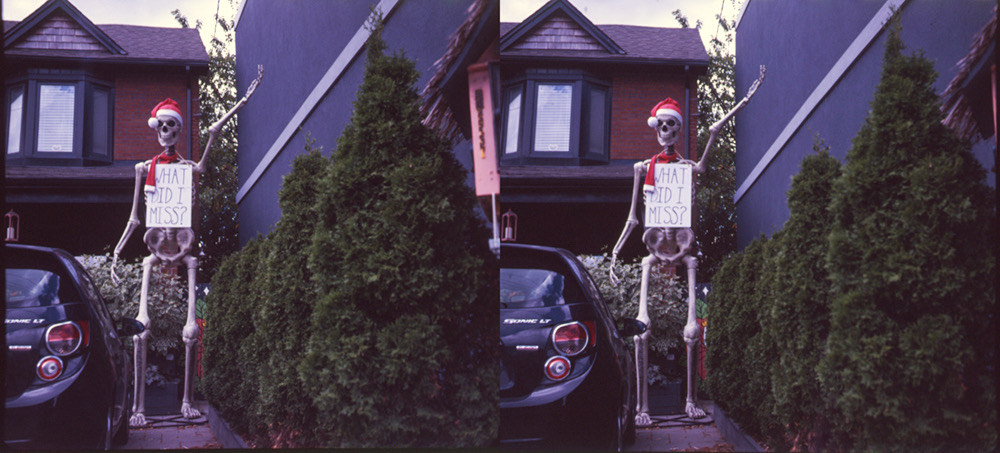
©2022 Steven Lederman, “What Did I Miss?” (cross-eye stereo); Toronto, Canada; Baby Rolleidoscop, home-rolled expired 46mm Ektachrome
 
 
 © 2022 Saku Tiihonen, The Bystander; Tampere, Finland; Kodak Brownie 127 (1st model), Fomapan 400 

  
 ©2022 Jodi Benaroch, It's Elementary; Atlanta, GA, USA; Kodak Brownie 127 with flipped lens, Kentmere Pan 100
 
 
©2022 Kenneth Loen, untitled; Seattle, WA, USA; Clix-O-Flex, Shanghai GP3


 © 2022 Salvador Busquets, Dry Collodion trials; Palau-Solità i Plegamans, Catalonia; Vest Pocket Kodak, Fomapan 100 cut to 127  
 

©2022 Doug Hollaway, Adrift; Hesperia, California, USA; Ensign E29, Kodak Verichrome Pan (expired 09/70)


©︎2022 Yoshinobu Imaoka, When we close the curtains, our secret begins.;  Okayama, Japan; Yashica 44; Fomapan 100
 
 
© 2022 Dale Willetts, Church oopsie; Claines Worcester, UK; Ensign E29, Ilford FP4 plus

 
 © 2022 Lionel Bouchpan-Lerust-Juery, Zug by the Lake; Zug, Switzerland; Yashica 44LM, Rera Chrome 100
 
 
© 2022 Terry Byrne, Working From Home, Princeton, New Jersey, USA; Topcon Primo Jr., Ilford HP5
 

 ©2022 Dave Hg (Dave Hughes), An Archetype; Markeaton Park, UK; Zeiss Ikonta 127, Verichrome Pan expired 1976
 
 
 © 2022 Michael C. Durling; Beach Balls; York River, Virginia, USA; Yashica 44a; Rollei Infrared film
 
 
©2022 Ph. Ostertag, Even « LGM » visit Geneva; Switzerland; Yashica 44, Rerachrome 100 


 ©2022 J. Mach, Railroad Tracks; Gilbert, Arizona, USA; Rolleiflex 4x4, ReraPan 100


©2022, Steven Aimone, Urban Decay: Concrete Railroad Bridge; Emma Road, Asheville, NC, USA; Ferrania Tanit, Rera Pan Film 127 B&W ISO 400


© 2022 Nicholas Middleton, Condemned Trees; London U.K; Baby Ikonta, Rollei Superpan


 ©2022 Umechan, Our rest spot.; Tokyo, Japan; Sawyer's Mark IV; Instax mini 
 
 
 ©2022 Eric the Red, Meandering Thoughts; Kingman, Kansas, USA; Kodak Baby Brownie Special, Bluefire Murano 160
 

©2022 Slim Blanks, Calla; Primarette, film unbranded and got in camera


©2022 John Alton, Lytton Park (127 Day); Toronto, Ontario, Canada; Primo Jr., Rerapan 400
 
 
© 2022 Eben Ostby, Garlic Hexaptych; Virginia, USA; Kodak (Nagel) Vollenda, Carestream green panoramic x-ray film cut to 300mm x 46mm on 127 backing paper


©2022 Jim Rohan, Thunder Cove Evening; Lower Darnley, Prince Edward Island, Canada; Kodak Baby Brownie Special, 46mm Ilford HP5+ 


©2022 Alessandro Lisci aka Roderick Usher, Sella del diavolo sole rosso sale; Sardegna, Italia; Brownie 127, Ferrania Solaris (expired 35 mm film) 

 
©2022 J. M. Golding, Unexpected magic; northern California, USA; Yashica 44A, Ilford HP5+


*and that's if you count all three Yashica 44 models as "the same."


Thursday, August 11, 2022

July 127 Day exhibition - deadline is tomorrow

This is just a quick reminder that the deadline to submit 127-format photos you made on the 12th of July 27, 2022 to the 127 Day Exhibition is tomorrow, Friday, August 12, 2022.

If you've already submitted, thank you!

If you haven't, and you have 127-format photos from that day, I hope you'll consider sending one.

I'm looking forward to seeing your 127 Day photos!


Friday, August 5, 2022

July 127 Day exhibition - deadline is in one week

This is just a quick reminder that the deadline to submit 127-format photos you made on the 12th of July, 2022 to the 127 Day Exhibition is in one week, on Friday, August 12, 2022.

If you've already submitted, thank you!

If you haven't, and you have 127-format photos from that day, I hope you'll consider sending one.

I'm looking forward to seeing your 127 Day photos!

Thursday, July 14, 2022

Ilford ULF window is open - a way to purchase bulk 127 film

 Ilford's annual Ultra Large Format (ULF) sale is open until Friday, August 19, 2022.

Once a year, Ilford opens the ULF ordering window. If they receive enough orders, they make the year's batch of "specialist" sizes of various films - including 50' rolls of 46mm wide HP5+ - also known as 127 size!

If you purchase a roll, you'll need to spool lengths of the film from the 50' bulk roll onto backing paper and spools, which you'll have to supply from elsewhere (re-use is definitely an option :-)

Participating retailers in many countries in Europe, North America, and Asia are listed here.


Monday, July 11, 2022

Tomorrow is 127 Day!

Tomorrow, Tuesday, the 12th of July, 2022, is 127 Day!

127 Film Photography will feature 127-format photographs made on the 12th of July, 2022, in a special online exhibition. You're invited to participate!

No fees, no competition, just a friendly virtual community joining together to make 127-format photos on
the 12th of July, 2022.

To show your work,

  1. Take 127-format photographs on the 12th of July, 2022.
  2. Send one of your 127-format photographs that you took on the 12th of July to 127 Film Photography. Please email one jpg file, 500 pixels wide, to 127filmformat ~at~ gmail.com, by August 12, 2022. (This allows a month to get your film developed and scanned).
  3. In the subject line of your email, type "July 2022 127 Day."
  4. In the body of the email, please include the following information: copyright symbol, year, your name, the title of the photograph, location, camera and film types, and your website address (or other link to your work). In that order. Please follow this example EXACTLY (you don't have to use initials if you prefer to be known by your full name!). If you want to direct people to an Instagram page, please use the URL for the page, not an "@" handle (which will not work as a link). 

© 2022 J. M. Golding, untitled; northern California, USA; Yogi Bear, Ilford HP5+  http://www.jmgolding.com

All types of 127 film format* are welcome, whether the film began its existence as 127, or you used 35 mm film in a 127 camera, or you respooled 46mm film, or you cut down 120 film to 127 size ... or maybe you have a technique that I don't know about yet - if so, please tell me so I can share it with others who love this format (with full credit to you, of course - or perhaps you'd like to write an article for 127 Film Photography about it!). Photos made on 127 film in a different size camera are welcome too.

127 Film Photography will publish all photos received (as long as they are in 127 format and do not contain images of nudity, violence, or exploitation). 
 
I look forward to seeing your 127 Day photos! 
 
 
*Sorry, digital photos in an aspect ratio similar to 127 film (or any other digital photos) do NOT qualify.


Tuesday, July 5, 2022

One week till 127 Day!

127 Day is only a week away - Tuesday, the 12th of July, 2022. It's time to take your film out of your fridge and load your 127-format camera.

127 Film Photography will feature 127-format photographs made on the 12th of July, 2022, in a special online exhibition. You're invited to participate!

No fees, no competition, just a friendly virtual community joining together to make 127-format photos on
the 12th of July, 2022.

To show your work,

  1. Take 127-format photographs on the 12th of July, 2022.
  2. Send one of your 127-format photographs that you took on the 12th of July to 127 Film Photography. Please email one jpg file, 500 pixels wide, to 127filmformat ~at~ gmail.com, by August 12, 2022. (This allows a month to get your film developed and scanned).
  3. In the subject line of your email, type "July 2022 127 Day."
  4. In the body of the email, please include the following information: copyright symbol, year, your name, the title of the photograph, location, camera and film types, and your website address (or other link to your work). In that order. Please follow this example EXACTLY (you don't have to use initials if you prefer to be known by your full name!). If you want to direct people to an Instagram page, please use the URL for the page, not an "@" handle (which will not work as a link). 

© 2022 J. M. Golding, untitled; northern California, USA; Yogi Bear, HP5+  http://www.jmgolding.com

All types of 127 film format* are welcome, whether the film began its existence as 127, or you used 35 mm film in a 127 camera, or you respooled 46mm film, or you cut down 120 film to 127 size ... or maybe you have a technique that I don't know about yet - if so, please tell me so I can share it with others who love this format (with full credit to you, of course - perhaps you'd like to write an article for 127 Film Photography about it!). Photos made on 127 film in a different size camera are welcome too.

127 Film Photography will publish all photos received (as long as they are in 127 format and do not contain images of nudity, violence, or exploitation). 
 
I look forward to seeing your 127 Day photos! 
 
 
*Sorry, digital photos in an aspect ratio similar to 127 film (or any other digital photos) do NOT qualify.